REVIEW · LEH
Leh Ladakh Motorcycle Tour / Private Luxury Car Tours
Book on Viator →Operated by Ladakh B2B · Bookable on Viator
Thin air, big views, and real logistics handled for you. This 7-day Ladakh circuit around Leh, Nubra Valley, and Pangong Lake is a standout mix of high passes and cultural stops, built around a bike option (every Saturday) and a private car option (every day). I especially like the practical way the tour layers in support: motorcycle setup from day 2, plus backup vehicle and mechanic from day 3, so you’re not stuck improvising when roads get tricky. The one real drawback to plan for is altitude and cold—Khardung La and Chang La sit above 5,300 meters—so you’ll want to pace yourself and come ready for thin-air driving.
What makes this feel “worth it” at about $393.25 per person is that the tour doesn’t just list places. It tries to remove the headaches that usually derail independent trips: permits and routing are handled, and your time goes to the scenery and the sights. You’ll also get a structured mix of iconic Leh landmarks and quieter off-the-main stops like Turtuk, which helps the trip feel more like a route through Ladakh than a checkbox tour.
One more consideration: entrance tickets and most monastery fees are not included. That means your budget should include monument admissions (and you’ll still need to bring your own riding protection like gloves and guards).
In This Review
- Key things to know before you go
- The value in this route: Leh to Nubra to Pangong, in a smart arc
- Day 1 in Leh: Shanti Stupa, Leh Palace, and the market streets
- Day 2 outside Leh: Hall of Fame, Gurudwara, Magnetic Hill, and Indus–Zanskar
- Khardung La and Nubra Valley: the highest motorable pass day
- Turtuk and Thang near the Line of Control: culture at the frontier
- Pangong Tso and Chang La: where the driving feels longer than the photos
- Thiksey, Druk Padma Karpo School, and Shey: the Leh return with meaning
- Motorcycles, luggage, and the support that makes or breaks a trip
- Price and what you’re really paying for at $393.25
- Who should book this Ladakh bike or private car tour
- Should you book it?
- FAQ
- Does the tour include pickup or airport transfers?
- How long is the Ladakh tour?
- Is this a motorcycle tour or a car tour?
- When do I get the motorcycle, and what model is it?
- Is fuel included for the motorcycle?
- Is luggage carried for me?
- Are meals included?
- Are entrance tickets included for monasteries and monuments?
- What bike gear do I need to bring?
- What happens if I cancel?
Key things to know before you go
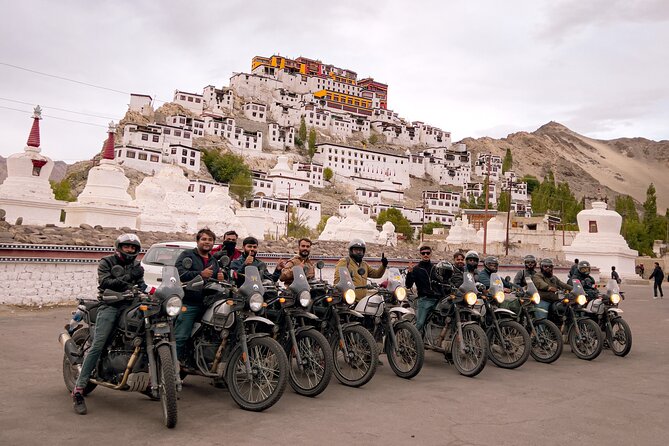
- Every Saturday bike tour / every day private car for the same broad Ladakh circuit
- Motorcycle starts day 2 (Himalayan 411 CC), with fuel included
- Luggage support and mechanic from day 3 to keep the ride moving
- Used helmets included, but you must pack your own biking gear
- High passes at Khardung La and Chang La with big elevation changes
- Meals are mostly covered: breakfast (6), lunch, dinner (6), plus airport transfers
The value in this route: Leh to Nubra to Pangong, in a smart arc
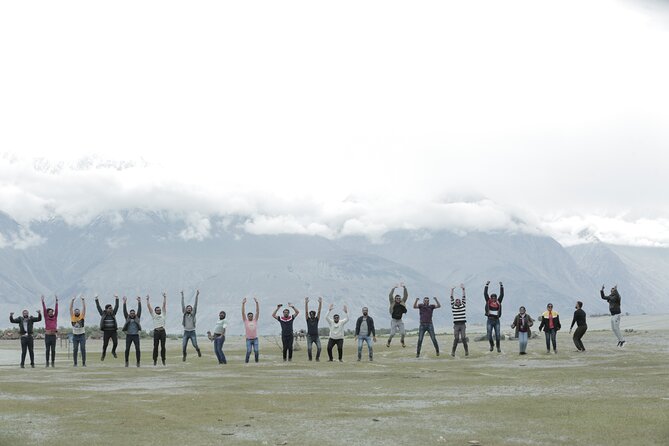
This tour works because it stacks Ladakh’s best “moods” in a logical order. You start in Leh with orientation and culture, then push outward into Nubra Valley where the terrain changes fast—monasteries, desert dunes, and valleys that feel otherworldly. After that comes Pangong Tso, where the day turns long and the altitude becomes more of a factor. Finally, you loop back toward Leh with monastery and school stops that keep the cultural side present even after days of riding.
The biggest practical win is how the company handles the parts you normally have to arrange yourself. In the reviews, people repeatedly highlight that routes, permits, and day-to-day moving parts were handled properly, which is exactly what you want in a place where one wrong plan can ruin your momentum.
Also, note the tour style: it’s a private tour/activity, meaning it’s only your group. That can make a huge difference when everyone’s trying to move at a similar pace and you don’t have to wait on a big mixed crowd.
You can also read our reviews of more tours and experiences in Leh.
Day 1 in Leh: Shanti Stupa, Leh Palace, and the market streets
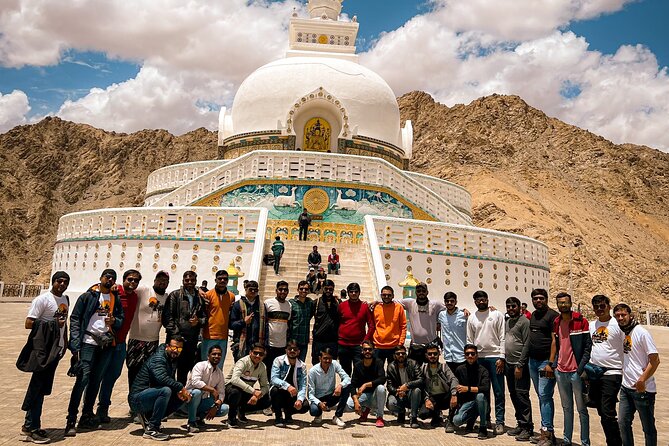
Day 1 is all about getting your bearings in Leh. You’ll visit three iconic stops, and the order matters.
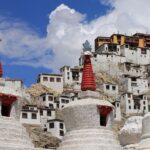
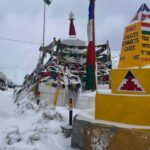
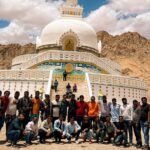
Shanti Stupa (the white-domed Buddhist monument) is more than a pretty viewpoint. It was built in 1991 by Japanese monk Bhikshu Gyomyo Nakamura and commemorates 2,500 years of Buddhism while promoting world peace. If you’re adjusting to altitude, it’s a good first stop because it’s calm and walkable, and you can take in the city from a steady, low-stress angle.
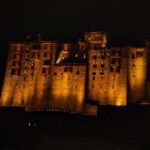
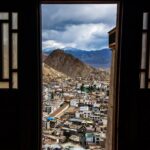
Then comes Leh Royal Palace, also known as Lachen Palkhar. It’s a 17th-century residence linked to King Sengge Namgyal and designed in a style that mirrors the Potala Palace in Lhasa. Even when you don’t spend ages reading every detail, the building helps you understand why Leh felt like a hinge point between cultures.
Finally, you get time at Leh Market. This is the part you’ll feel most in your hands—woolens, pashmina-type goods, and everyday shopping in the middle of town. It’s also where you can grab small essentials you might forget for high passes: extra layers, gloves liners, or simple personal comforts.
One watch-out: Shanti Stupa and Leh Palace admissions are listed as not included. That’s normal for big monuments. Just budget for it so you don’t feel surprised later.
Day 2 outside Leh: Hall of Fame, Gurudwara, Magnetic Hill, and Indus–Zanskar
Day 2 takes you beyond Leh town for a mix of history, spirituality, and those classic oddball geography stops.
At the Hall of Fame, you’ll see exhibits dedicated to the Indian Army, including themes tied to the Kargil War and Siachen Glacier. If you’re the type who likes context—why people fought for these heights—that museum tends to make the rest of the trip feel more grounded.
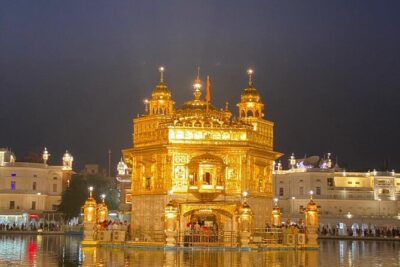
Next is Gurudwara Shri Datun Sahib Ji (Pathar Sahib), about 25 km from Leh on the Leh–Kargil road. It’s a revered Sikh shrine at around 12,000 feet. The altitude part matters: by now, you’re not just sightseeing—you’re experiencing the real feel of high-altitude travel, even on “easy” stops.
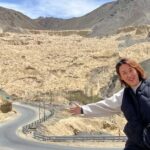
Then you’ll visit Magnetic Hill, a well-known gravity hill site. It’s short and quick, but it’s fun in that straightforward roadside way. You’ll likely stop, take photos, and move on.
After that, comes the confluence of the Indus and Zanskar rivers near Nimmu village. Seeing rivers join in this kind of terrain gives you a different mental picture of Ladakh—less about “empty space,” more about how water shapes everything.
All of these are mostly low-ticket or free stops, but it’s still smart to carry small cash for anything you decide to add on the spot. The tour guide can help you decide what’s worth your time.
Khardung La and Nubra Valley: the highest motorable pass day
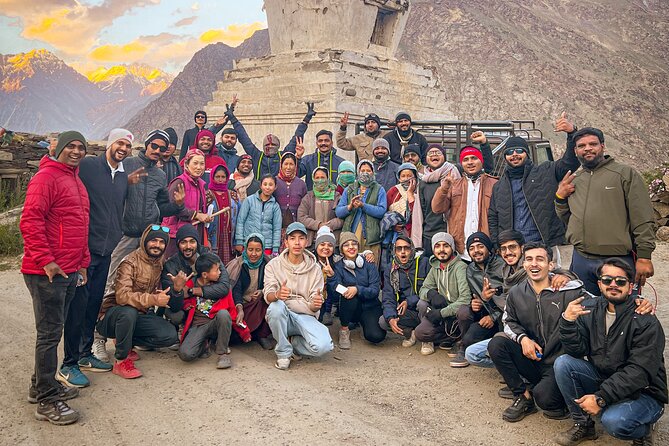
Day 3 is the dramatic one for many people, because it pairs a big-altitude driving moment with a monastery and a high-altitude desert.
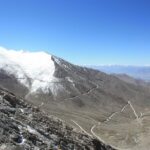
You’ll cross Khardung La, listed at 5,359 meters. It’s one of the highest motorable passes and serves as a gateway to Nubra Valley. Even without getting technical, you should treat this as the “focus day.” Keep your mind on steady driving, slow turns, and not rushing photos at the wrong time.
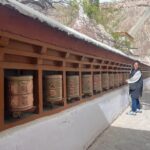
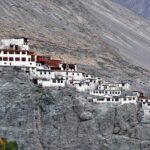
Next is Diskit Gompa, the oldest and largest Buddhist monastery in Nubra Valley. It was founded in the 14th century by Changzem Tserab Zangpo, who was a disciple of Tsong Khapa. Monasteries like this aren’t just architecture—they’re visual proof of how old spiritual networks shaped daily life in remote regions.
Then you reach Hunder Sand Dunes. These dunes sit at about 10,000 feet and have a silver-hued look that makes them feel almost unreal against the mountains. It’s one of those places where you’ll want a little time to wander, even if you’re not doing anything extreme.
A practical note: Khardung La is marked free for admission, but Diskit Gompa is not included. Also, this is typically the day where cold can sneak in. Layers matter even if the morning is sunny.
Turtuk and Thang near the Line of Control: culture at the frontier
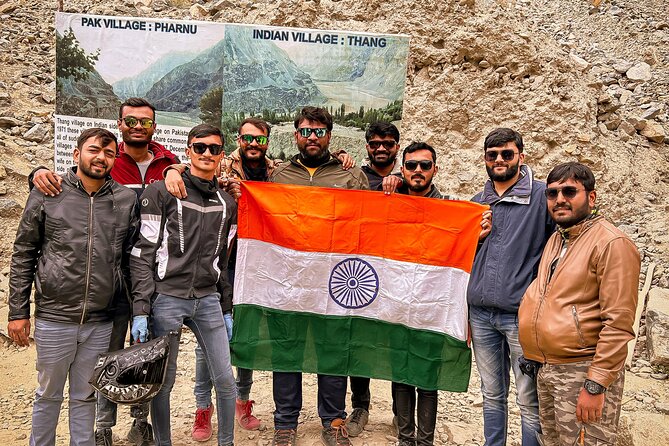
Day 4 shifts from dramatic scenery to people and place.
You’ll arrive at Turtuk, a village with Balti heritage. Expect stone houses, apricot orchards, and local market life. The tour also calls out places like the 16th-century Polo Ground, the Brokpa Fort, and the Balti Heritage Ho (as listed). Even if you don’t linger at every stop, the idea is clear: Turtuk is about identity and survival, not only views.
Next comes Thang (also called Dhothang or Thanga Chathang). This is described as a remote settlement about 2.5 km from the Line of Control that divides India and Pakistan. That proximity changes the tone of a sightseeing day. You’ll likely feel like you’re seeing how geography and politics shape day-to-day life.
Then there’s Turtuk Waterfall, reached through a scenic hike through apricot orchards. The hiking time listed here is short—about 30 minutes—so it’s more of a legs-and-air break than a major trek. Still, it’s a good choice if you want one grounded nature moment inside a road-heavy itinerary.
Most of these are free on admission in the tour plan, but local experiences can still add small costs. Keep your spending flexible.
Pangong Tso and Chang La: where the driving feels longer than the photos
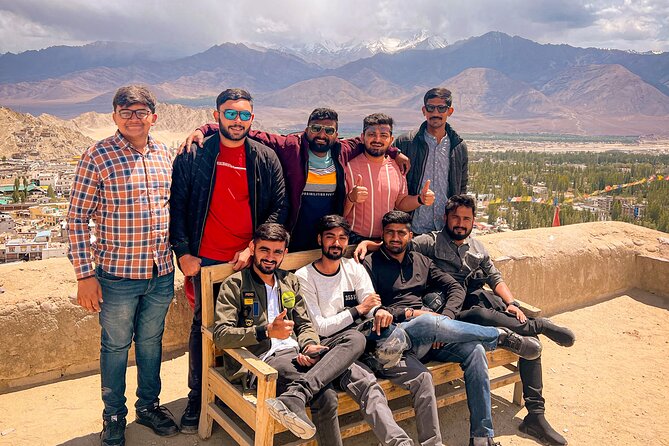
Day 5 is Pangong Tso, the high-altitude brackish lake at about 4,350 meters, stretching about 134 km and across both sides of the region. This is the day people remember because the lake changes light fast. You can take photos all you want, but the real value is the slow shift in color as the sky moves.
You’ll likely spend around an hour at the lake per the schedule. That can be enough if you come with a plan: one photo spot, one quiet walk, and then time to sit and watch clouds. If you try to do everything at once, it gets stressful at high elevation.
Day 6 pairs Pangong’s area with Chang La Pass, again at about 5,360 meters. Chang La connects Leh to Pangong and Nubra Valley routes, making it a key artery for this circuit. After that, you’ll pivot back toward culture and viewpoints near Leh.
This is a big day for your body, even if you’re not “doing” anything physical. High altitude riding can tire you in the background. If you’re prone to headaches, nausea, or feeling out of breath, the solution is simple: take the stop breaks seriously and don’t treat them like photo opportunities only.
Thiksey, Druk Padma Karpo School, and Shey: the Leh return with meaning
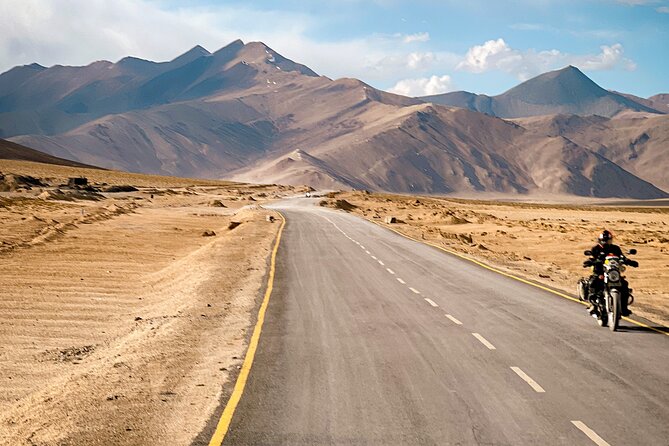
After Chang La, the itinerary keeps culture present with monastery and learning-related stops near Leh.
First is Thiksey Monastery, perched on a hill about 19 km east of Leh. It’s described as the largest Buddhist monastery in central Ladakh, founded in the 15th century, and linked to the Gelugpa (Yellow Hat) sect. The hilltop setting gives you a different perspective than the flatter town viewpoints from Day 1.
Then you’ll visit Druk Padma Karpo School, often referred to as Rancho’s School because of the film 3 Idiots. The tour lists that the school was established in 1998 by Druk Padma Karpo Education Society, with a mission to support education in the region. Even if you’re not there to read every detail, it gives your trip a human center—Ladakh isn’t only mountains.
Finally, Shey Monastery (15 km south of Leh) is listed. It was constructed in 1655 by King Deldan Namgyal to honor his father, Sengge Namgyal. The mention of a 12-meter-high copper statue is a great anchor detail. It’s one of those places where the scale hits you quickly.
Entrance tickets are not included for Thiksey and Shey in the schedule, so again, budget for monument admissions if you want to avoid awkward moments.
Motorcycles, luggage, and the support that makes or breaks a trip
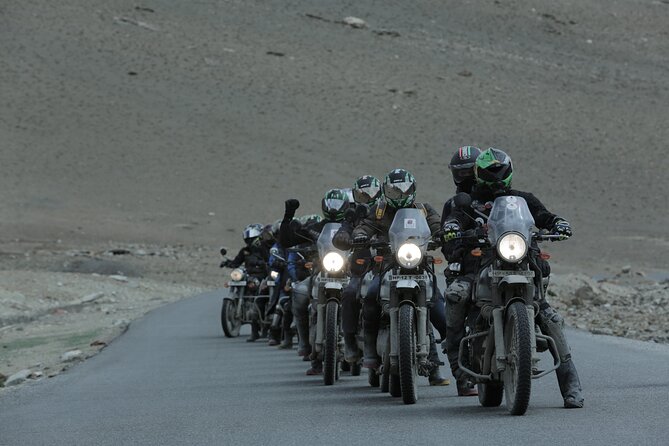
This tour is built around riding, but it doesn’t ask you to carry everything or handle mechanical surprises alone.
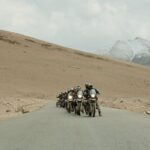
From day 2, you ride the Himalayan 411 CC motorcycle. Fuel is included, so your ride feels more continuous. You’re also assigned a tour captain/marshal/guide from day 2, which matters because it’s not just directions—it’s pace, safety, and keeping the group together.
From day 3, the tour includes a professional backup vehicle to carry your luggage. That’s a big deal. It means you can ride without turning your bike trip into a moving hotel backpack.
Also from day 3, there’s a mechanic throughout the trip. That aligns with what people praised in the reviews: there’s always backup support, and bikes are in good condition.
You’ll receive used helmets, which is better than nothing. But you still need to pack your own biking gear. The tour explicitly lists elbow and knee guards, gloves, and a jacket as not included. If you’re renting gear elsewhere, plan time. If you show up without it, the tour can’t magically supply it.
One more practical point: if you want a “luxury car” version of this circuit, the operator runs a private car journey every day. Your itinerary still follows the Ladakh flow, but you avoid the mechanical/helmet/guard side of the trip.
Price and what you’re really paying for at $393.25
At $393.25 per person, this is in the category where value comes from bundling. You’re not only paying for the sights. You’re paying for:
- Accommodation on a double/triple sharing basis (as listed)
- Meals: breakfast (6), dinner (6), and lunch
- Motorcycle and fuel starting day 2
- Guide/captain/marshal
- Luggage vehicle and mechanic starting day 3
- Airport transfers
- Used helmets
That’s a lot of overhead for one package. In hard-to-plan places like Ladakh, bundling like this often matters more than the sticker price. If you’ve ever tried to organize a route, permits, transport, and mechanical backup yourself, you’ll understand why riders feel less stressed on a supported itinerary.
The main cost you should anticipate outside the package is entrance tickets for monuments and monasteries, since those are listed as not included.
Who should book this Ladakh bike or private car tour
You’ll love this if you want:
- A structured 7-day circuit that hits Leh, Nubra Valley, and Pangong Tso
- A riding-focused trip with motorcycle support rather than DIY pressure
- A private group feel, not a big public tour crowd
You might not love it if:
- You’re sensitive to altitude and you prefer lower-elevation days
- You hate being responsible for your own riding gear (because protections like gloves and guards are not included)
- You want lots of unscheduled free time. This itinerary is paced with planned stops and set durations.
It also helps to know the schedule rhythm: the bike group tour runs every Saturday, while the private car runs every day. If your dates are flexible, that can open up options.
Should you book it?
If you want Ladakh without the usual planning pain, this tour is a strong choice. The standout value is how much support it stacks in—motorcycle setup, fuel, backup vehicle for luggage, and a mechanic from day 3—so you can spend your energy on the road and the sights.
I’d book it if you’re comfortable with high-altitude driving and you’re willing to bring your own riding gear. If you want a gentler approach, choose the private car option and keep the same overall route, just with less bike hardware to manage.
If you do book, do two things early: pack your protection (gloves and guards matter) and budget for entrance tickets at monasteries and major monuments. Then you’ll be free to enjoy what Ladakh does best—big heights, clear air, and a route that feels like a journey instead of a waiting room.
FAQ
Does the tour include pickup or airport transfers?
Pickup is offered, and airport transfers are included in the package.
How long is the Ladakh tour?
It’s listed as 7 days (approximately).
Is this a motorcycle tour or a car tour?
It offers a bike group tour every Saturday and a private car journey every day.
When do I get the motorcycle, and what model is it?
The motorcycle (Himalayan 411 CC) is included from the 2nd day.
Is fuel included for the motorcycle?
Yes, fuel for your motorcycle is included.
Is luggage carried for me?
A professional backup vehicle to carry your luggage is included from the 3rd day.
Are meals included?
Yes. Breakfast is included for 6 days, dinner is included for 6 days, and lunch is included.
Are entrance tickets included for monasteries and monuments?
No. Any entrance or monuments tickets are not included.
What bike gear do I need to bring?
Biking gear is not included, including items like elbow and knee guards, gloves, and a jacket.
What happens if I cancel?
You can cancel up to 3 days in advance for a full refund. If you cancel less than 3 days before the start time, it is not refunded.